Structure Of Shell And Tube Heat Exchangers
 May 17, 2026|
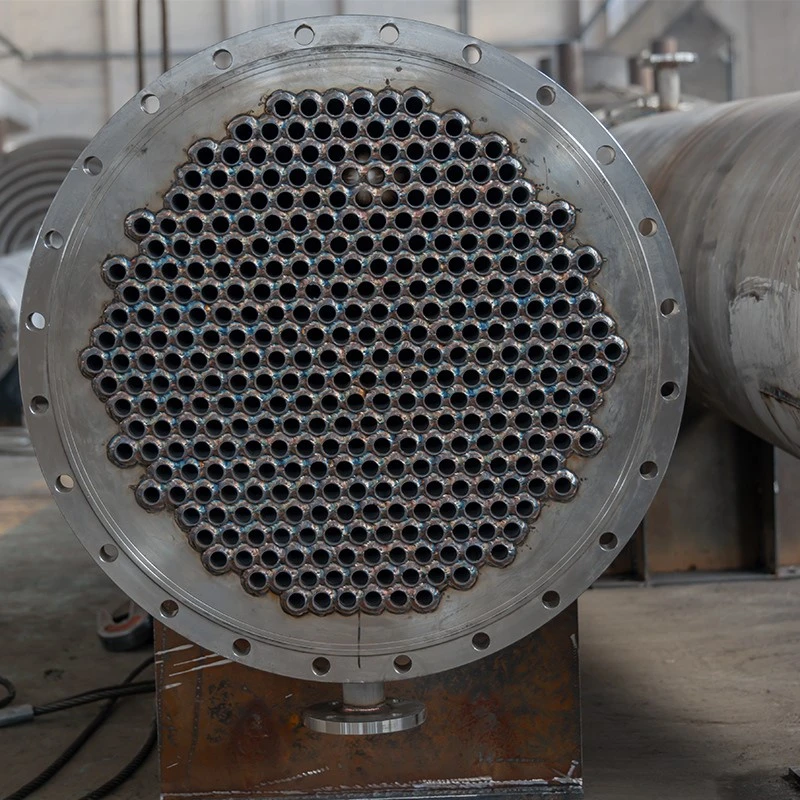
A shell-and-tube heat exchanger consists of a shell, heat transfer tube bundles, tube sheets, baffles, and tube boxes. The shell is typically cylindrical, containing the tube bundles fixed to the tube sheets at both ends. The two fluids exchanging heat are called the shell-side fluid and the cold fluid; one flows inside the tubes. To improve the heat transfer coefficient of the fluid outside the tubes, several baffles are usually installed inside the shell. These baffles increase the velocity of the shell-side fluid, forcing it to pass through the tube bundle multiple times along a predetermined path, thus enhancing turbulence. The heat exchange tubes can be arranged in an equilateral triangle or a square on the tube sheet. An equilateral triangle arrangement is more compact, resulting in higher turbulence and a larger heat transfer coefficient; a square arrangement facilitates cleaning of the outside of the tubes and is suitable for fluids prone to scaling.
The main control parameters of a shell-and-tube heat exchanger are heating area, hot water flow rate, heat exchange capacity, and heat transfer medium parameters.
One pass of the fluid through the tube bundle is called one tube pass; one pass through the shell is called one shell pass. The diagram shows the simplest single-shell-pass, single-tube-pass heat exchanger, often abbreviated as a 1-1 type heat exchanger. To increase the fluid velocity inside the tubes, baffles can be installed in the tube bundles at both ends, dividing all the tubes into several groups. In this way, the fluid only passes through a portion of the tubes at a time, thus traversing the tube bundle multiple times; this is called multi-tube pass. Similarly, to increase the flow velocity outside the tubes, longitudinal baffles can be installed inside the shell, forcing the fluid to pass through the shell space multiple times; this is called multi-shell pass. Multi-tube pass and multi-shell pass heat exchangers can be used in combination.