




Working Principle And Key Factors Affecting The Heat Transfer Performance Of Finned Tube Heat Exchangers
 May 16, 2026|
In the energy cycle system of industrial production, industrial finned tube heat exchangers act as highly efficient "energy hubs," undertaking the core task of heat transfer and conversion. Compared to radiators, which primarily dissipate heat, finned tube heat exchangers focus more on the heat exchange between two or more fluids, making them key equipment for achieving industrial energy conservation and process optimization.
Industrial finned tube heat exchangers are structured around a base tube and fins. The base tube, serving as the fluid channel, is typically made of carbon steel, stainless steel, copper, or alloy materials, requiring a balance between thermal conductivity and corrosion resistance. The fins are tightly bonded to the surface of the base tube using processes such as high-frequency welding, expansion, or mechanical winding. Common fin types include straight fins, serrated fins, and spiral fins. When hot and cold fluids flow inside and outside the tube respectively, the significantly increased surface area of the fins greatly enhances the heat transfer coefficient, facilitating rapid heat transfer from the hot fluid to the cold fluid. For example, in an air-cooled finned tube heat exchanger, air flows outside the fins, and the heat from the medium inside the tube is efficiently transferred to the air through the fins, achieving cooling or heating.
The unique structure of industrial finned tube heat exchangers gives them outstanding performance advantages. Firstly, their heat transfer efficiency far exceeds that of ordinary bare tube heat exchangers. The presence of fins increases the heat transfer area several times over, achieving higher heat exchange capacity within the same space, making them particularly suitable for applications with limited space but high heat loads. Secondly, these heat exchangers possess excellent adaptability. By adjusting the fin spacing, thickness, and base tube diameter and arrangement, they can flexibly adapt to the heat exchange needs of various media, such as steam-liquid and gas-gas exchanges. Furthermore, strong corrosion resistance is another major highlight. For special environments such as chemical and marine engineering, corrosion-resistant materials and protective coatings can be selected to ensure long-term stable operation of the equipment.
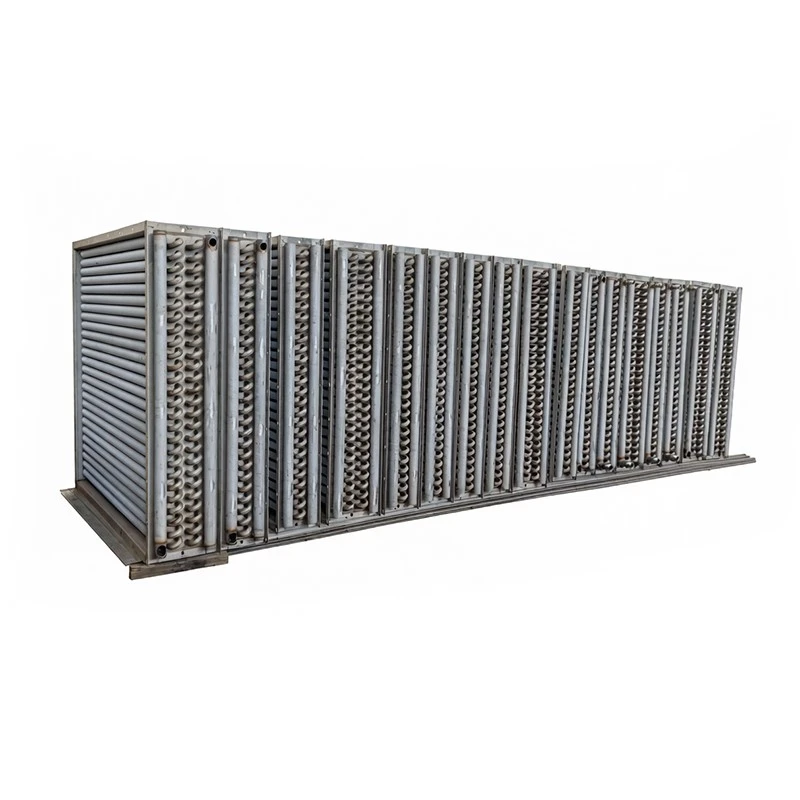
Industrial finned tube heat exchangers play an irreplaceable role in numerous fields. In the petrochemical industry, it is widely used in crude oil distillation and cracking reactions to cool high-temperature oil products and heat reaction feedstocks, ensuring precise temperature control and efficient energy utilization in the process. In the power industry, air-cooled finned tube heat exchangers are commonly used in condensers and cooling tower systems of thermal power plants to condense steam into water, achieving water resource recycling. In the refrigeration and air conditioning field, finned tube heat exchangers, as core components of evaporators and condensers, achieve cooling or heating functions through heat exchange between refrigerant and air. In the new energy field, such as solar thermal systems and fuel cell systems, finned tube heat exchangers also undertake crucial heat conversion tasks, contributing to the efficient development and utilization of new energy sources.
With the advancement of Industry 4.0 and green manufacturing concepts, industrial finned tube heat exchangers are developing towards intelligence, high efficiency, and energy saving. In terms of intelligence, the integrated sensors and intelligent control system can monitor parameters such as temperature, pressure, and flow rate in real time and optimize the heat exchange process through algorithms. The innovation of high efficiency focuses on the research and development of new fin structures, such as biomimetic fins and microchannel fins, to further improve heat transfer performance. Under the trend of energy saving, the combination of waste heat recovery technology and finned tube heat exchangers is becoming increasingly close. By recovering waste heat in industrial production, it can be used to preheat raw materials or provide domestic heating, thereby reducing energy consumption.